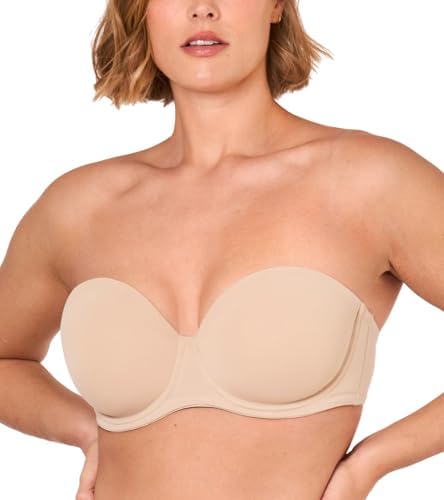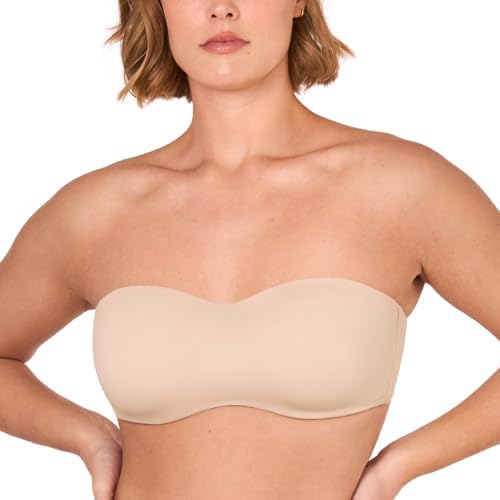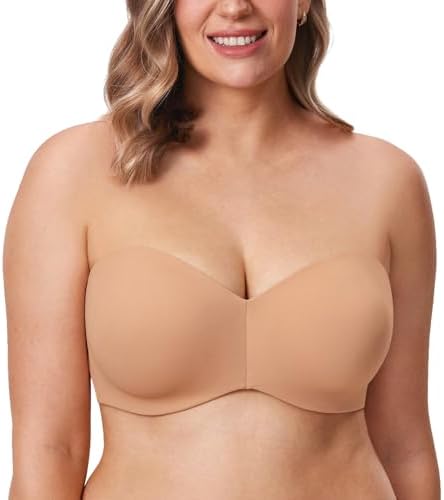
What keeps a strapless bra up
Without shoulder straps the weight falls on the band, the silicone grip and the boning in the side wings.
4 min read
A strapless bra depends almost entirely on the ribcage band to support full cups without slipping down.
Band tension carries the weight
A standard bra divides the load between the ribcage band and the shoulder straps. Remove the straps, and the band has to do all the anchoring on its own. That is why our strapless cuts fit noticeably firmer than our everyday styles in the identical band size. The back panel uses dense elastic that anchors flat against the ribs to keep the underwires planted where breast tissue meets the chest wall.
If the band rides up your back, the cups will immediately tip forward and drop in front. You need a snug fit on the loosest row of hooks from the first try. That leaves the remaining tighter rows available once the elastic relaxes over months of wear. Check our printed chart against your snug ribcage measurement in inches to pick the right base size.
Silicone grip along the edges
We line the top and bottom inner edges of our strapless bands with thin silicone strips. This material adheres lightly to clean skin, creating friction that stops the fabric from sliding downward as you move your torso. It works best on dry skin without lotions, body oils, or talc applied underneath the band line.
The silicone ribbons run across the upper cup rim and along the entire circumference of the wings. This placement holds the cups flush against upper breast tissue so the top edge does not curl outward under clothing. Wide side wings work alongside the grip material to spread the tension across a broader area of skin, which avoids uncomfortable pinching while maintaining stability.
Boning stabilizes the side wings
Heavy breast tissue pushes down and outward inside the cups, which can cause soft wing fabric to buckle or roll. To prevent this collapse, we sew flexible vertical boning into the side seams directly under the armpits. These lightweight stays keep the tall side wings upright and smooth against your flanks throughout the day.
The boning transfers downward pressure from the cup cradle into the lower band elastic instead of letting the fabric fold. This structure keeps the side wire positioned correctly behind the breast tissue, rather than digging into the front of the bust. Together with enclosed underwire channeling, the stays create a rigid frame that holds its shape under tension.
Structured cups versus soft bandeaux
A basic bandeau is a tube of knitted stretch fabric that compresses tissue flat against the ribs. It offers light coverage but lacks the internal architecture required to lift and separate heavier cups. Full busts placed in a soft tube usually experience downward drift and unseparated shape because there is no wire or seam structure beneath.
Our strapless bras use three-part cut and sew cups with firm lower cradles to build projection and lift without bulk. The underwires enclose each breast individually, maintaining separation at the center gore. This cut supports the bust from underneath rather than squashing it flat, which keeps your natural profile intact under structured necklines or open-shoulder tops.
When to use detachable straps
Most of our strapless bras come with a pair of matching detachable straps in the package. These straps give you options for specific necklines, including crisscross back configurations, halter ties, or classic dual-strap placement. The attachment points sit inside reinforced fabric loops hidden along the interior of the top cup edge and back wing.
Clip the straps in place whenever your outfit covers the shoulders but you want extra security during long hours of walking or dancing. Adding the straps back distributes part of the upward lift to the shoulders, easing some of the direct grip pressure around your ribcage without changing the smooth look of the cups.
Put it to work
The finder runs the chart these notes describe: two numbers in, a band and cup out, plus a count of what we cut in it.